Faced with a fixed warehouse footprint, diverse material types, and plateauing manual efficiency, how can warehousing be transformed? For a plastics enterprise in Changzhou, Wayzim delivers a definitive solution: maximize vertical space and boost efficiency via intelligent systems.
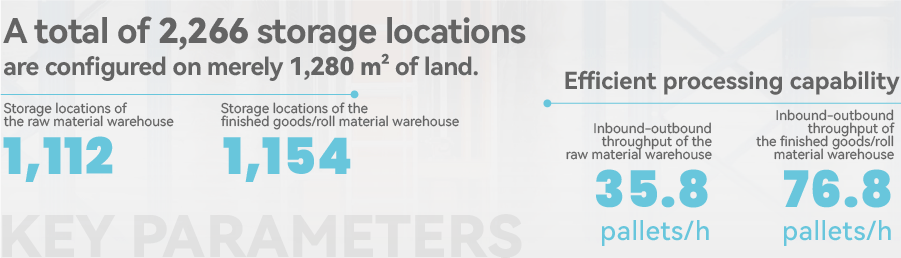

Located in Changzhou, Jiangsu, the warehouse covers an area of approximately 1,280 m². The customer required storage and material handling for multi-category stock including raw materials, finished goods, and roll materials within limited premises. Based on on-site layout planning, Wayzim built an efficient vertical AS/RS.
The AS/RS integrates automated storage equipment, intelligent conveyor systems, and an information management platform to enable fully automated inbound, storage, and outbound workflows, significantly improving warehousing efficiency and management and addressing pain points of conventional warehousing such as wasted space, low operational efficiency, and high manual error rates.

l Diverse materials with broad dimensional variations
Raw materials, finished goods, and roll materials vary significantly in dimensions, making conventional rack systems poorly suited to them.
l Underutilized vertical space
Vertical space utilization must be maximized within a limited site, with clear heights ranging from 22.5 m to 23.3 m.
l Experience-reliant management
Traditional manual records and dispatching cause high error rates and sluggish response.

Step 1: Segmented Storage Zoning
Raw material area: 8-level heavy-duty racking with 1,112 storage positions, designed for heavy-duty loads.
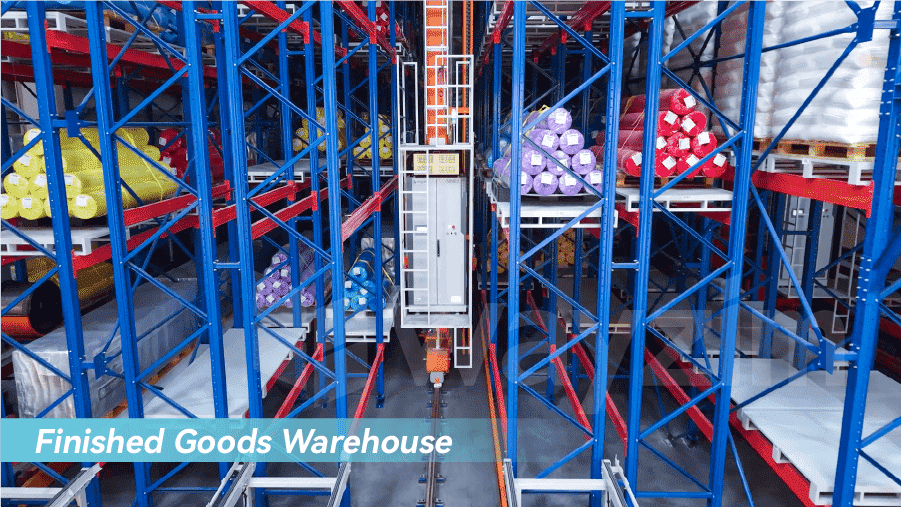
Finished goods area: a 12-level single-deep racking system and an 11-level double-deep racking system, providing 1,154 storage locations. Both standard cases and irregular roll materials can be stored.
Step 2: Automated Equipment for Material Handling
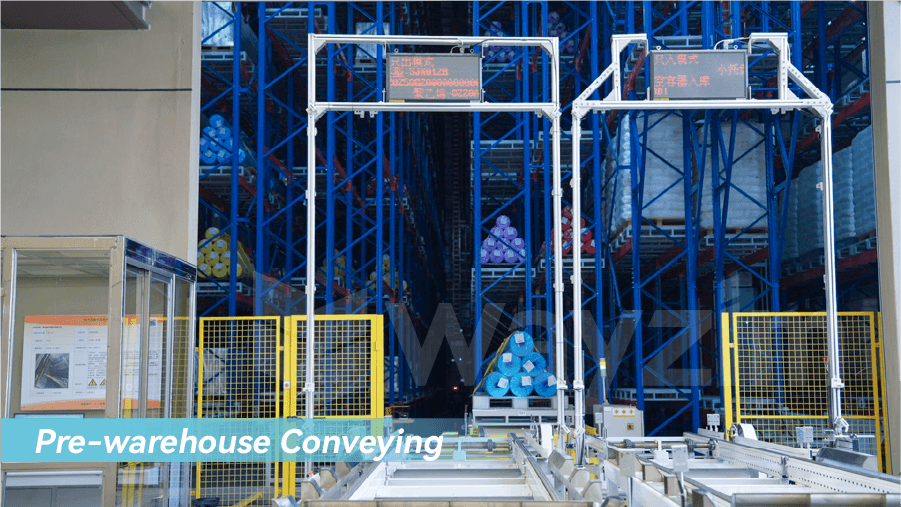
Inbound: Automatic dimension inspection, weighing, and material data reading.
Storage: Stacker cranes work in coordination with RGVs to execute precise storage and retrieval.
Outbound: Conveyor systems automatically perform sorting and outbound operations according to task commands.
Step 3: Deploying a Digital Brain for the Warehouse
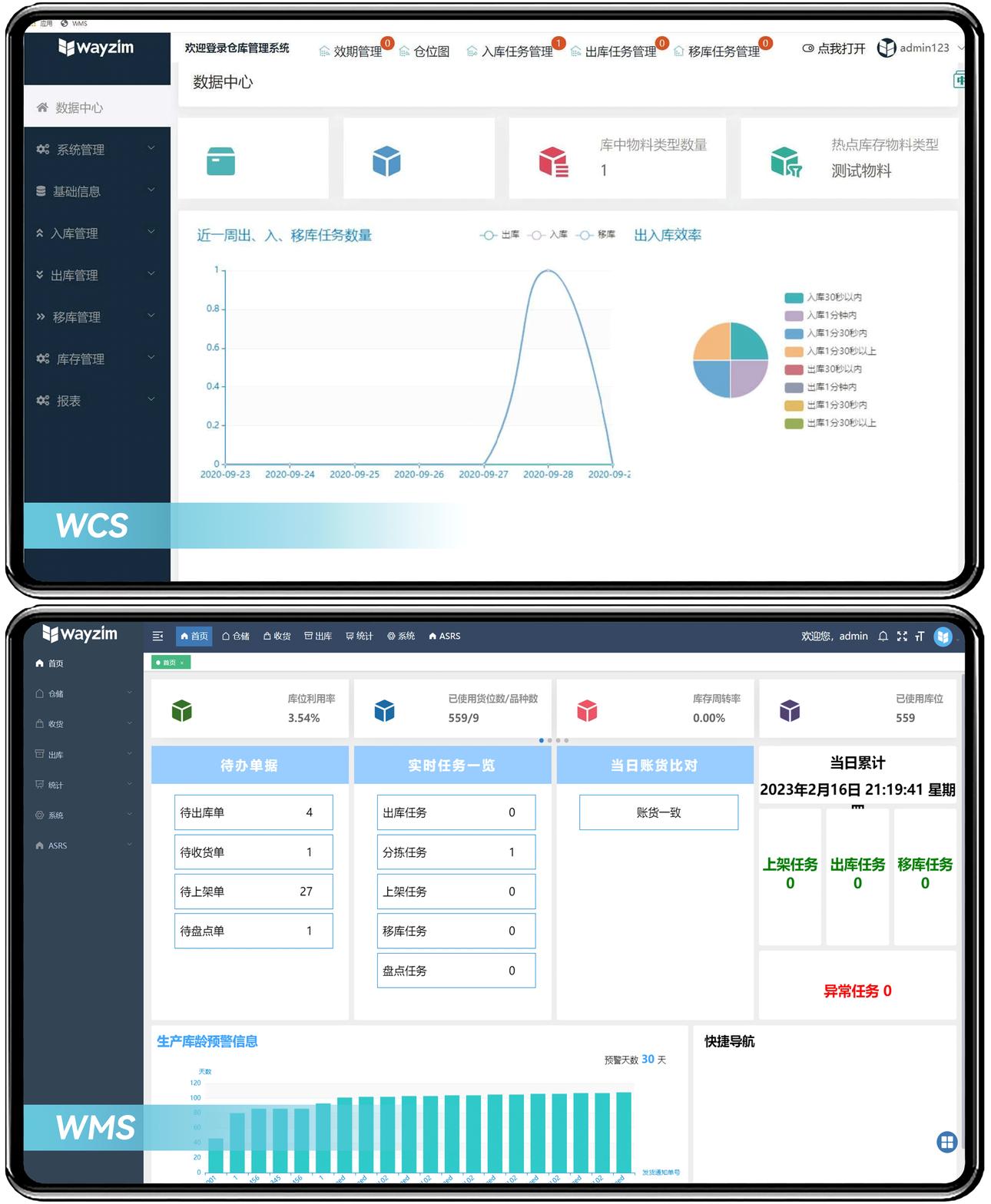
The WMS supports dynamic storage location allocation, batch management, and the First In, First Out (FIFO) strategy.
The WCS monitors the equipment status in real time, delivering fault alerts and enabling rapid responses.
Synchronization between the information system and equipment minimizes manual intervention and improves operational accuracy.

01 Finished Goods Warehouse Efficiency up to 76.8 Pallets/h
Automated equipment enables efficient inbound and outbound operations. The finished goods warehouse achieves an efficiency of 76.8 pallets/hour, meeting high-velocity turnover requirements.
02 Space Utilization Tripled Compared with Conventional Warehouses
High-bay racking (up to 22.97 m) and dense storage design;
03 Inventory Accuracy up to 99.99%
The WMS supports customized strategies, enabling granular control;
04 Overall Operating Costs Reduced by over 40%
Fully automated operations reduce reliance on manual labor;
05 Multiple Safety Devices Including Fall Protection and Anti-Collision
Ensure the safety of materials and equipment.
Summary
This vertical-space-oriented warehousing upgrade deeply integrates customized design, end-to-end automation, and intelligent dispatching systems. It not only resolves complex multi-SKU inventory management bottlenecks but also provides a replicable, scalable intelligent reference model for intelligent upgrading across industry. Moving forward, Wayzim’s smart warehousing solutions will be deployed at more manufacturing facilities, helping more customers improve warehouse floor space efficiency.